Resicom Expands to Kansas City

March 4th, 2010

Lemont, IL


It should be normal that the companies you hire make you better.


Therefore, Resicom is pleased to announce the expansion of our self performing reach with the opening of our Kansas City office.

By positioning talented, experienced members of the Operations & Technicians team in the area, Resicom is even better equipped to develop industry innovations and deliver consistency.


At Resicom, we understand the constraints and demands facing facility and property management.  We feel it should be normal that when management hires a vendor, that vendor should make their business stronger.  Resicom’s ability to service multiple trades and manage projects in an efficient and effective manner creates value and brings normalcy to the lives of our facility and property partners.


Resicom now has satellite offices and key team members in Kansas City, San Diego, Columbus, Tampa, Dallas and Chicago.

Resicom CEO Invited to Participate on DePaul University Panel

February 26th, 2010

February 2010

Lemont, IL


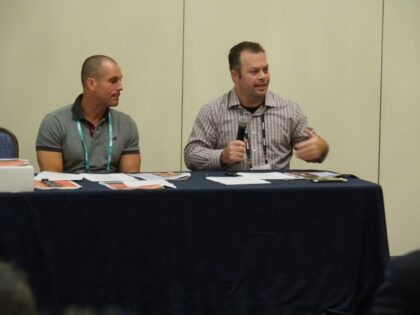
Resicom CEO John Fairclough has been asked to speak as part of a peer panel for the DePaul University Coleman Entrepreneurship Center.

The event is being held Friday, March 12, 2010 at the Naperville campus.


At this event, four seasoned business owners offer their insight to company issues in a town hall-style discussion by integrating their experiences, best practices, ideas, and recommended resources.  Business owners in the audience are encouraged to share their own experiences and thoughts in this open discussion.  The objective is that participants will leave with new ideas and approaches to not only address the challenges you currently face, but also to resolve future issues that may arise.


“Beyond a consultant’s expertise, a professor’s wisdom, and a thought leader’s acumen, most entrepreneurs believe they get the greatest value learning from the experience of those who have “been there and done that”.


John is the entrepreneurial founder of Resicom, a dynamic and successful company that believes in the bold pursuit of what normal should be.  It should be normal that the companies you hire make you better.  Resicom embraces its role in client brand and asset protection through facility maintenance and repair.


John continues to evolve in his own role as CEO and company visionary for Resicom.  Since founding the company in 1996 John drives the team to continually examine and fine-tune performance, while providing insightful options and experience upon which clients have come to depend.

Reflections on RFMA

February 19th, 2010

Lemont, IL

Resicom team members Marty Durkin and Michael Fairclough have returned from Dallas after attending the annual RFMA (Restaurant Facility Management Association) conference earlier this week.   National Business Development Manager Marty Durkin judged the conference as an overall success, having had the opportunity to network with top restaurant facility management while taking part in educational seminars and discussions on industry trends.

“The focus of the restaurant industry is maximizing their facility spend,” says Durkin.  “It’s a universal truth that everyone is asked to do more with less.  But especially for restaurant facility managers who are feeling the pinch, those choices become critical to boost market share.”

At Resicom, we understand the constraints facing restaurant facility management in the current economic environment. We feel it should be normal that when a restaurant facility manager hires a vendor, that vendor should make their business stronger.  Resicom’s ability to service multiple trades and manage projects in an efficient and effective manner creates value and brings normalcy to the lives of our facility partners.

Valentine’s Day in Dallas :: Resicom Attends RFMA

February 12th, 2010

Lemont, IL

Resicom Solution Team Members travel to Dallas over Valentine’s Day weekend to attend the annual RFMA (Restaurant Facility Management Association) conference.   The conference provides an opportunity for top restaurants and service providers to network, attend educational seminars and discuss key trends in the restaurant maintenance industry.

Resicom has spent several months creating a unique live fish tank that will be a focal point of the booth.  The idea was the result of a recent project moving 55-gallon salt water tanks from the lobbies of more than 20 different restaurant locations.

“The tank is a visual of our ability to think out of the box and create options to solve our clients’ challenges,” says Marketing Manager Laurie Ledonne.  “This was a unique project where we leveraged our strengths in structure and innovation to open possibilities.”

National Business Development Manager Marty Durkin and Executive VP Michael Fairclough will be in attendance at the conference.   Durkin has been appointed to RFMA Ethics Advisory Committee, and will divide his time between the board meetings/ responsibilities and representing Resicom on the trade show floor.

Resicom is committed to the bold pursuit of what normal should be.  It should be normal that the vendors restaurant facility managers hire make their business stronger.  Resicom will continually strive to uphold this truth and create value for our facility partners.

Keeping the PACE with current market trends

February 11th, 2010

Lemont, IL

Resicom representatives recently returned from the Painting and Decorating Contractors of America and SSPC (The Society for Protective Coatings) annual conference in Phoenix Arizona. The premiere paint and coating show provided Resicom Project Developer Brian Perla the chance to participate in hands-on educational demonstrations and seminars, while meeting with industry colleagues.
Resicom is committed to exploring innovation that helps facility maintenance management make savvy spending decisions. Perla believes the conference was invaluable providing applicable insight regarding new green technologies in coatings, advancements in waterborne dye stains and urethanes, and new sprayer technologies. Perla found the experience share regarding and general industry trends in response to the current economic climate extremely beneficial.
“It’s always exciting to see painting industry experts together in one place,” says Perla. “The new technologies being developed are unlike anything seen before. Being informed and educated on new coatings and applications is a service we can then provide to our clients to help solve their facility challenges.”

Resicom is committed to the bold pursuit of what normal should be. It should be normal that the vendors facility managers hire make their business stronger. Therefore, Resicom is completely committed to development. Resicom believes that only through our own training, education and self-awareness can we be of greater value to our clients.

Not A Paper Pushing Job

January 22nd, 2010

How can you replace wallpaper around customers and staff without disrupting the retail experience?


Project Overview

A client determined that the damaged wallpaper in a high traffic area was distracting customers from their shopping experience.  The need to return the facility to normal was paramount to the client in that they specifically requested the work to be conducted during regular business hours rather than overnight.  However, the project had to be completed without disrupting the normal flow of business.

Scope

The scope of work needed to execute this project included:

1. Remove damaged sheet of wall paper in a high traffic area.

2. Repair damaged drywall under the existing paper prior to replacing the wall paper.

3. Install section of new wall paper, while integrating it with the old wall paper.

4. Execute the project during business hours.

Challenges & Solutions

The constraints of the project that were overcome included:


1. Avoiding additional damage to wallpaper surrounding area that needed to be replaced.

    • The seams had to be carefully removed so that the older paper surrounding the damaged piece was not torn or damaged.


2. Ensuring repaired section of wallpaper is indistinguishable and new seams are tight.

    • Resicom verified that the new section of wallpaper matched the existing section exactly, and that all seams were aligned in perfect coordination.


3. Completing the Project During Business Hours without disrupting the flow of business.

    • Days known for slower retail traffic were scheduled over high-traffic weekends.
    • The crew systematically worked in marked off sections to have the least impact on the customers’ ability to access merchandise and move freely through the store.


4. Keeping customers out of the area being painted.

    • Project Manager remained onsite to ensure that customers were protected from any potential hazards and to stay in constant communication with both management and Resicom technicians.
    • Project management also coordinated the relocation and protection of the large amount of breakables and delicate merchandise.

Summary

The execution of project was unique because we were working during business hours.  Resicom is confident that detailed project management and execution will not have adverse effect on a retailer’s daily revenue.  Regardless of working conditions or environment, Resicom is able to execute project completion that is consistent with our standards.

The Graffiti Problem

January 18th, 2010

Protect or Repaint?


During the 1980’s, urban culture began to find new ways of expression in music, dance and art. Tagging became an art form as the talents of the early Generation X’ers combined spray paint and public spaces to promote just about everything. Needless to say. tagging is a nuisance in the vast majority of instances, and over the past 20+ years coating companies have created an array of defenses to (as David Horowitz put it) Fight Back!


The purpose of this monograph is to provide an abridged, but accurate description of the options available to retailers in terms of anti-graffiti coatings.


Serve and protect

Coatings have a function that is more important than color – substrate protection. Coatings do this by providing a thin film (measured in thousandths of an inch) that provides a barrier between the environment and the substrate. This small film is the only thing used to fight graffiti – so it has to be tough, right? Sometimes. Lets explore the types of films used.


Type 1 Permanent

Spray paints are low viscosity solutions laden with hydrocarbon solvents. These

solutions are sprayed onto a surface and the paint converts from a liquid to a solid by means of solvent evaporation (for further explanation, see Monograph titled Film

School). A Type 1 Permanent Anti Graffiti coating’s method is resilience. The film

created by Type 1 coatings are typically 2 component, networked films which dry by

cross-linking. The net result is a film that is both impervious (to combat the low

viscosity penetration of spray paints), as well as chemically resilient. Paint removers can be applied directly to the spray paint with a rag, and removed but the Type 1 coating will remain in-tact. A common assumption is that these coatings make graffiti “fall off” the wall – this is untrue. The system simply works like a dry erase board and is ideal for protecting murals and specialty surfaces like decorative stone.


Type 2 Sacrificial

Type 2 coatings work completely differently. Instead of providing a film that is

networked, hard and chemically resilient, it provides a film that is easily removed!

When spray paint is used over these coatings, a property owner will simply

pressure clean the affected area using tap water. The mechanical force applied by

the water stream will remove the Type 2 coating along with any graffiti that is

sticking to it. After cleaning, the Type 2 coating will need to be re-installed. This is

both time consuming and can be expensive, however is an ideal system for

concrete, stone or brick surfaces where a Type 1 (impervious) coating will not

allow the necessary vapor migration to occur. Think of it like a wax film.


Type 3

Type 3 is a reality check. Since both Type 1 & Type 2 coatings require a technician visit to remove the graffiti, it is often less money to simply paint over the graffiti with an attic stock of the original coating. Often times, poor record keeping result in technicians painting over graffiti coatings because they are not aware of their presence – this negates any value in either Type 1 and 2 systems.

Resicom Published Again

January 15th, 2010

Blogspot Press Release


Lemont, IL


Known as the nationwide company to experience normalcy, Resicom strives

ways to bring clarity and options for solutions to facility maintenance

challenges.


We are pleased to announce that Executive VP Michael Fairclough has again

been published in Retail Facility Business. His article “Voc”abulary discusses

how volatile organic compounds affect the environment, and what that

means for the painting industry. The abundance of chemical compounds in

our atmosphere and oceans, mixing through the soil has created an

unsustainable cycle. In response, regulations to reduce the amount of VOC

allowed in a given gallon of paint have been enacted. A can of paint from

1989 is much different in application and aesthetic from one purchased

today, and facility maintenance providers must plan accordingly.


With a background in chemistry coupled with a project specific approach to

solutions, Michael has written and implemented solutions for hundreds of

projects- ranging from historical preservations to the latest retail concepts.

As Executive VP, Michael focuses on research and development and

information systems to create and audit the unique processes which drive

Resicom’s business structure. Michael is equally insightful in researching

and implementing new technology systems that promote our ability to

leverage innovative programs and communication tools into knowledge for

our clients.

Ceramica

January 13th, 2010

Tile installations date back to 2500 BC – yes, BC. People discovered that if you take natural clay and mix with minerals, heat them to extreme temperatures then allow them to cool, you end up with the world’s first honey-do task – maybe. Tile has proven to be the most versatile decorative finish that humans have engineered, in fact silica tile is used to protect the space shuttle as it re-enters the Earth’s atmosphere. This monograph will offer an abridged but accurate description of a two tile types that are used in retail environments, ceramic and porcelain.

Though the terms are often used interchangeably, they are in fact different. To add to this confusion, Ceramic is also the term used to define the entire set of inorganic materials prepared by heating and cooling, which includes ceramic tiles and porcelain tiles. For sake of clarity, when the term ceramic is used to reference the tile type (subset), it will not be underlined.

Constituents of Ceramic & and Porcelain tile types-

Much like concrete, tiles are a mixture of materials found in the Earth’s crust.

Clay + sand + feldspar + minerals + water comprise the bulk of the mixture for both ceramic and porcelain.

Differences between Porcelain tile and Ceramic tiles-

Porcelain tile contains a higher ratio of feldspar and lower ratio of clay than ceramic. Feldspar (pictured) is a silicate mineral which is both hard and can withstand high temperatures. Another difference between ceramic and porcelain are the pressures used to prepare them. Porcelain tile types are made using higher pressures – resulting in a harder surface. As a general rule, porcelain tiles are harder than ceramic. In addition, the porosity of the porcelain tile is less, providing better stain resistance than ceramics. Porcelain tiles are ideal for exterior applications.

To glaze or not to glaze-

Both tile types come in glazed and unglazed finishes. Glazing is an added step in the manufacturing process which involves the coating of the unbaked tile with a glass like film. To do this, extreme temperatures are used, and the glaze penetrates into the bulk of the unbaked tile (bisque) – sealing and encapsulating the tile, rendering it relatively impervious. The higher the luster of a tile, the greater the stain resistance. Although a performance benefit, glazed tile can be an end use disadvantage as it is slippery and will highlight an uneven floor or wall surface.

Mortar and grout-

Mortar is the term used to describe the cementitious compound in which the tiles are set. Once the tiles are set in the mortar, the mortar cures and mechanically locks the tiles in place. The width between each tile is the grout line. In America, these are spaced between 1/16” – 3/4”. Grout selection is made based on the desired width, as well as environment. For small widths (less than 1/8”), a non sanded grout should be used. Between 1/8” – 1/4”, a finely sanded grout works best and coarser grouts for widths greater that 1/4”. In harsh environments, epoxy resins can be added to the grout to provide sealed and chemically resistant spacing.

Ben Bodell Joins the Resicom Team

January 7th, 2010


Ben Bodell


Lemont, IL


Resicom brings normalcy to facility maintenance by opening possibilities with smarter spending, transparency and brand wide consistency.  We are always looking to add great people to the team to provide objective clarity and solutions to our clients.


Therefore, we are pleased to announce the addition of Ben Bodell to the position of Project Developer.  Ben will work in a hybrid role where he will largely split his time between expanding our national client base with our Business Development Team, and lending his copywriting talent and project management experience to the Marketing Team.


Ben brings a diverse background in the building retro-fit and clean tech fields. He recently worked developing and marketing energy management initiatives for the City of Boston, and has previously worked as a consultant on energy performance contract negotiations as well as structured finance for project development.  Resicom looks forward to Ben lending his expertise as we expand our national client base, in-house marketing, and sustainability (green) offerings.


“Our facility management partners look to Resicom to provide not just maintenance solutions, but to provide innovative green and sustainable energy options too,” says Team Development Manager Laurie Ledonne.  “Ben will be a vital part of these endeavors and dialogues with clients, as Resicom moves towards LEED and other certifications.”

“Resicom has a dynamic, visionary team with a solid foundation for growth.  I’m delighted to join Resicom at a such an exciting time as we work to expand our services throughout the nation,” says Bodell.


© 2010 Resicom

Resicom's services include general facility maintenance - such as carpentry, painting, tile, handyman work, as well as, enviromental branding, capital improvement and renovation projects. Resicom services clients nationwide.
12305 S. New Avenue, Suite H | Lemont, IL 60439 | p 630 257 9201 | f 630 257 9205